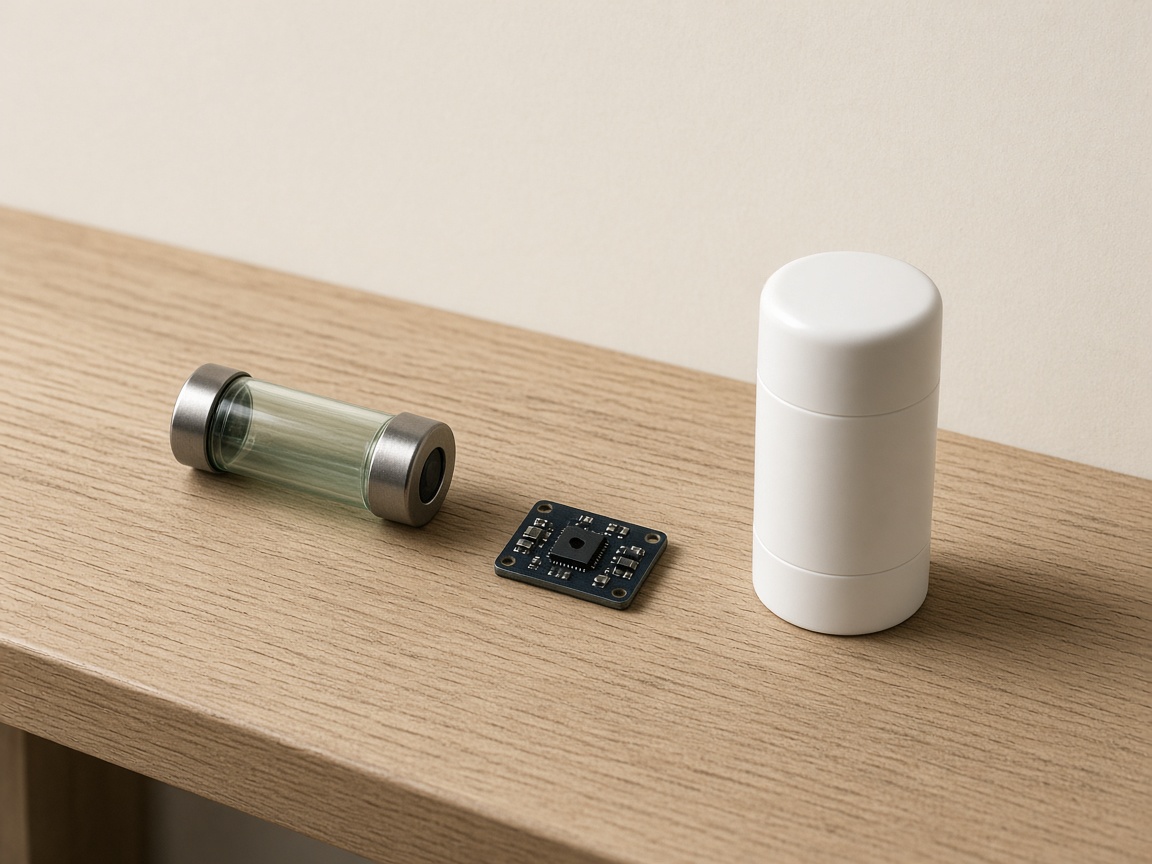
Optical particle sensors count or size scatter. Carbon dioxide uses NDIR or photoacoustic infrared. Formaldehyde pages that say “electrochemical” name a third family. TVOC pages that say MOS name a fourth. Mixing those families in one title does not make one sensor do all four jobs.
What each family is looking at
Tyler Cipriani and Jeff Geerling both name Plantower PMS5003 as a laser particle sensor. RevK’s kitchen note treats a cooking plume as a particle event that went “off the scale”, with carbon dioxide rising as a separate observation. Adafruit names NDIR for carbon dioxide. Those are four different physical measurements: scatter from particles, infrared absorption or photoacoustics for carbon dioxide, an electrochemical cell for a target gas, and a heated metal-oxide film for a broad VOC response.
A laser channel that moves is still a particle event. It is not a size-bin table from this publication, and it is not a gas identification.
Why a cooking spike is not a formaldehyde result
A laser PM channel can move when oil, toast or a candle starts. That movement is a particle event. It does not identify a gas. It does not say the air is toxic. It does not raise HCHO unless an identified formaldehyde method is also in the record. HSE’s carbon-dioxide page is a ventilation document; it is not a particle-mass method.
Related retail copy that prints PM2.5 and HCHO in the same title still has to name both principles in the body before either column is treated as evidence.
What this page leaves blank
No µg/m³ value on this site is a calibrated mass concentration. No cooking curve is published. A trend needs the event log beside the file. See cooking and open windows.
Sources and scope
Sources checked on 23 September 2026. Numbered references point to the original publishers. Their sample measurements are not AirMeasure UK measurements. Manufacturer, tutorial and official material is identified separately.
- Tyler Cipriani, Monitoring my indoor air quality ↗29 May 2023. Bedroom AQI chart aligned with cooking spikes and with a filter change at 2023-05-19T22:25 MDT. Sensor named as Plantower PMS5003. The author cites literature that the sensor is “in the right direction” and needs factory calibration before it approaches a dearer reference. No reference instrument table is published there.
- Jeff Geerling, Monitoring my home’s air quality with AirGradient DIY ↗8 September 2021. Lists SenseAir S8, Plantower PMS5003 and SHT30. A basement office sat near 900 ppm with the vent open and passed 3000 ppm after hours with it closed. Case heat raised temperature and humidity. Automatic baseline calibration was written as needing about two weeks, during which carbon dioxide could read about 200 ppm high. Those figures are the author’s.
- RevK, Understanding CO₂ air quality better ↗Same author, 21 March 2019. Cooking sent particles “off the scale” and also raised carbon dioxide. A curtain-blocked window barely dropped the bedroom reading. The author questions treating a weekly minimum, or outdoor air, as a 400 ppm zero.
- Adafruit Learn, Adafruit SCD-30 NDIR CO₂ ↗Tutorial stating the SCD-30 is NDIR true carbon dioxide: “Unlike the SGP30, this sensor isn’t approximating it from VOC.” Field recalibration needs a known concentration. Automatic self-calibration is written as needing regular exposure near 400 ppm, continuous power, and about seven qualifying intervals of at least 18 hours (about five days). Component retailer, repeating a manufacturer specification.
- HSE, Using CO2 monitors ↗UK workplace ventilation page. Prefers NDIR on a portable device; head height; more than 50 cm from people; away from doors, windows and supply vents. A single snapshot can mislead. Persistently above 1500 ppm is written as a sign of poor ventilation. In a room with an air cleaner, carbon dioxide does not stand in for ventilation. Workplace guidance, not a home health standard and not an instrument certificate.
No instrument in this note has been tested or certified by this publication. Evidence policy · Corrections
Write the conditions beside the reading.
The CSV has column headings and one empty row. It contains no fabricated sample readings.
Download air-quality event record ↓